Henna for eyebrow styling

Table of Contents+
If you type “eyebrow henna” into Google, you’re probably looking for a way to enhance your eyebrows. The problem is that today, this single term refers to two completely different products.
Interestingly, when many people say “henna,” they actually mean… eyebrow dye. It’s not their fault. Over the years, the market has gotten us used to this terminology, which is why so many myths have sprung up around henna.
In this article, we’ll explain:
- what real eyebrow henna is,
- how henna differs from eyebrow dye,
- for whom henna is the best choice,
- why powdered henna isn’t always better than dye,
- which henna shades are worth choosing,
- how to achieve long-lasting and beautiful eyebrow pigmentation.
Why is there so much confusion surrounding henna for eyebrows?
Just a few years ago, most eyebrow coloring products were commonly referred to as henna. Over time, genuine henna products based on Lawsonia leaves appeared on the market, which is why they began to be referred to as “powder henna” to distinguish them from products that had been on the market previously.
The result?
Today, a client walks into the salon and says:
“I’d like some henna.”
After a brief conversation, however, it turns out that she’s expecting the kind of result typical of eyebrow dye.
That’s why the first step to successful coloring is always understanding what the client really expects.
What is real henna for eyebrows?
Real, natural henna for eyebrows is made from Lawsonia inermis—a plant known for hundreds of years as a natural source of pigment.
In professional eyebrow styling products, such as Rarity henna, the Lawsonia-based formula has been enriched with carefully selected ingredients that deliver modern shades and consistent coloring results.
The most important feature of eyebrow henna is how it works.
Henna does not require an oxidizing agent (hydrogen peroxide) to initiate the pigmentation process. The pigment activates as soon as it is mixed with water or a special henna activator designed for use with this product.
It is this feature that distinguishes henna from classic oxidative hair dye.
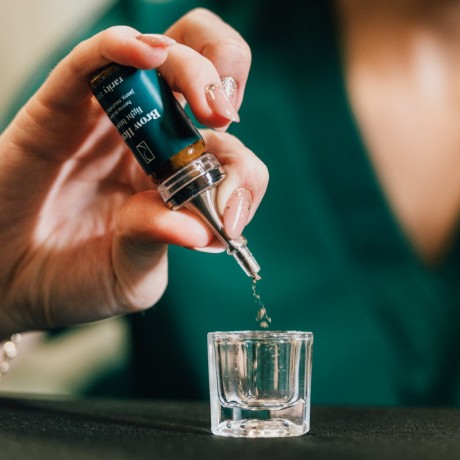
Henna activator or plain water? Why do we recommend an activator at Rarity?
Technically, henna powder can be prepared using water.
However, we recommend using a dedicated henna activator.
Why?
Because water quality can affect the final coloring result. Water hardness and the minerals it contains can cause variations in the shade of the finished mixture.
The Rarity activator was developed to ensure the most consistent results possible for every eyebrow styling session.
Additionally, it contains nourishing ingredients such as glycerin, aloe vera, panthenol, and green tea extract, which help ensure a comfortable application and maintain the skin’s condition during the treatment.
How does henna affect the hair and skin?
This is one of the biggest differences between henna and eyebrow dye.
Henna forms a layer of pigment on the hairs and skin, creating the appearance of fuller, optically denser eyebrows. When properly prepared, henna maintains a long-lasting, intense effect on both the skin and the hairs.
It is precisely this ability to intensely pigment the skin that makes henna for eyebrows such a popular choice among people with gaps in their eyebrow arches or very fine hairs. Eyebrow henna creates the effect of optical thickening and filling in gaps, which cannot be achieved with dye alone.
After the treatment, the color may continue to develop slightly, which is why the final result of eyebrow coloring is often not fully visible until a few hours later.
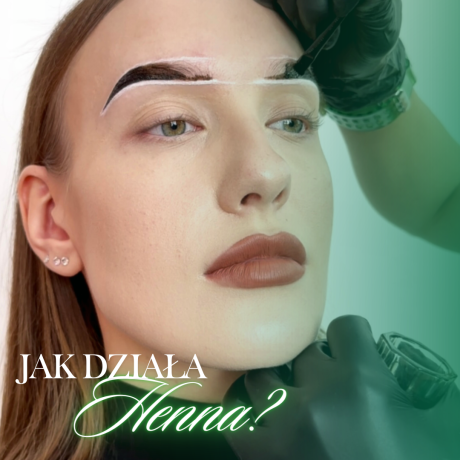
How does eyebrow dye work?
Eyebrow dye works completely differently.
It requires an oxidizing agent to work. During the coloring process, a chemical reaction occurs that permanently changes the hair’s color and produces a more natural-looking result on the hairs themselves.
This is precisely why eyebrow dye typically provides longer-lasting color on the hairs.
Skin pigmentation, on the other hand, is significantly less long-lasting than with henna.
Henna vs. Eyebrow Dye – Key Differences
| Henna for eyebrows | Eyebrow dye |
|---|---|
| Activates when mixed with water or an activator. | Requires an oxidizing agent. |
| Provides excellent skin pigmentation. | Focuses mainly on coloring the hairs. |
| Effectively conceals gaps in the eyebrows. | Provides a very long-lasting effect on the hair. |
| It does not permanently change the hair color. | It permanently changes the hair color through oxidation. |
| It requires very thorough skin preparation. | It is less demanding in terms of skin preparation. |
Is henna for eyebrows better than hair dye?
No.
And that’s one of the biggest myths in the beauty industry.
There is no one product that’s perfect for everyone.
Henna and eyebrow dye simply serve different purposes.
If a client wants a more intense color on the skin and the appearance of thicker eyebrows, henna is an excellent choice.
If, on the other hand, a permanent change in hair color is the priority, dye may be the better option.
A professional stylist doesn’t choose a product because it’s trendy, but because it best meets the needs of a specific person.
Who is henna best suited for?
Henna is a great option for people:
- with sparse eyebrows,
- who have thin or delicate eyebrow hairs,
- who want to make their eyebrows appear fuller,
- who want a more pronounced color on their skin,
- who like the look of eyebrow makeup and perfectly defined eyebrows.
When should you avoid henna?
A professional stylist should always postpone a henna treatment in the following cases:
- damaged or irritated skin,
- active inflammation,
- allergic reactions,
- a recently performed eyebrow lamination.
Before the first treatment, it’s also a good idea to perform a patch test according to the manufacturer’s instructions.
The secret to long-lasting eyebrow henna begins before the coloring process
Many people believe that the longevity of the henna effect depends solely on the product itself.
That’s not true.
Proper skin preparation plays a huge role—it’s the foundation for achieving a natural look that lasts as long as possible.
At Rarity, we recommend the following procedure:
- thoroughly cleanse the eyebrows—we recommend using Chrissanthie shampoo, which also removes excess oil,
- preparing the skin with floral water, which deeply moisturizes,
- if necessary, a gentle exfoliation specifically for the skin around the eyebrows,
- applying henna to color the eyebrows,
- finish the treatment with eyebrow oil.
This creates much better conditions for the pigment to settle evenly on the skin, resulting in long-lasting henna on the eyebrows and a beautiful color.
Which shades of henna should you choose for your eyebrows?
Today’s market offers a wide range of shades for eyebrow coloring—from blonde and red to graphite and black henna. Powder henna is ideal when you want to select a shade tailored to the client’s specific beauty type.
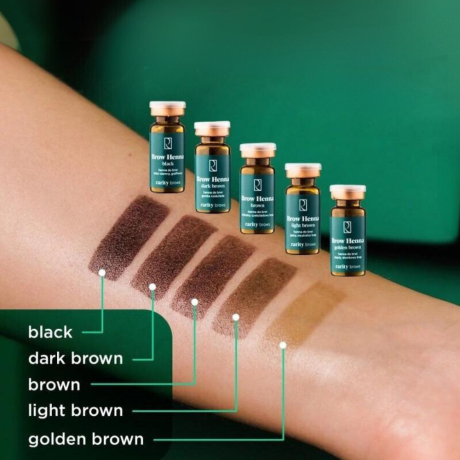
Rarity’s lineup features five carefully selected, versatile shades of powdered henna:
- Light Brown – a delicate, light shade of henna, perfect for blondes and those with fair complexions who want to subtly highlight their eyebrows without looking overdone.
- Golden Brown – a warm, golden shade of powdered henna that works great for people with red or warm-toned blonde hair.
- Brown – the most versatile henna shade, suitable for most beauty types and the most popular choice among clients.
- Dark Brown – an intense, deep shade of henna recommended for people with dark hair and a deep complexion.
- Black – the perfect black henna for clients who dream of sharply defined, striking eyebrows and the most intense effect possible.
A well-chosen shade is not just a matter of aesthetics—it also ensures that the eyebrow coloring will look natural, not artificial.
The Biggest Myths About Eyebrow Henna
Myth 1. Henna is always natural.
Not all professional eyebrow henna consists exclusively of plant-based ingredients. Modern products often also use other substances to ensure stable and predictable coloring results.
Myth 2. Henna lasts longer than hair dye.
It depends. Henna usually produces a more visible effect on the skin, while hair dye often maintains the hair color change for longer. So these aren’t competing products, but solutions designed for different needs.
Myth 3. Eyebrow henna dries out the hair.
A poorly performed treatment and a lack of proper care can worsen the condition of the hairs. That’s why, after coloring, it’s a good idea to use oil-based care products, which help maintain the hairs’ elasticity and healthy appearance without shortening the duration of the henna effect.
Myth 4. A green color in henna means the product is bad.
Not always. The final shade can be influenced by how the mixture is prepared and the quality of the water used. That’s why professional stylists are increasingly using dedicated henna activators instead of just any tap water.
Summary: Henna or eyebrow dye?
Although the word “henna” is used very broadly today, it’s worth remembering that henna and eyebrow dye are two different products that work in different ways.
It’s not a matter of which one is better.
It’s about which one will be the best choice for a specific client.
At Rarity, we believe that a knowledgeable stylist can choose the right eyebrow coloring method based on the client’s needs, hair type, and desired result. It is this knowledge—not chance—that allows for beautiful, long-lasting, and safe eyebrow styling.
We recommend Rarity powder henna, available in five shades—from Light Brown to Black—as a trusted choice for professional stylists.
Eyebrow Henna – Frequently Asked Questions
Can henna stain the skin?+
Can henna be applied after eyebrow lamination?+
Why didn’t the henna take?+
Do oils wash away the henna?+

She is the founder and CEO of Rarity Shop and Rarity Academy. She holds a master’s degree in cosmetology and has been advancing the eyelash and eyebrow styling industry for over 15 years as an educator, entrepreneur, and creator of professional products.
Meet the author →Powiązane produkty


Podobne wpisy
Wispy Lashes—What Are They and How Do You Achieve the Look?
Beauty Advent Calendar 2026
What's New in Korean Eyelash and Eyebrow Lamination. How to Choose the Right Products for the...
Eyebrow Lamination: The 5 Most Common Mistakes (and How to Avoid Them)
Korean eyelash lamination - what is it and where to start?
Allergies to eyelash glue: how to minimize the risk of reaction and what is the difference...
Glue holder, i.e. a jade stone for eyelash styling
Eyebrow shaping for men - how to do it properly?
Eyebrow gaps, or what to use to paint your eyebrows to cover gaps?
First eyebrow shaping at a beautician – when should it be done?